


 077 900 32 32
What is dental pulp and what are its functions
 Creation date
31.03.2025
Creation date
31.03.2025
At Club32, we remind our patients that inside every tooth there is a tissue that plays a key role in its vitality and sensitivity. It responds to irritation, supports the tooth with nutrients, and helps the body signal when something is wrong.
In this article, we explain what the dental pulp is, which functions it performs, why it can become inflamed, and what happens inside the tooth when pulpitis develops.
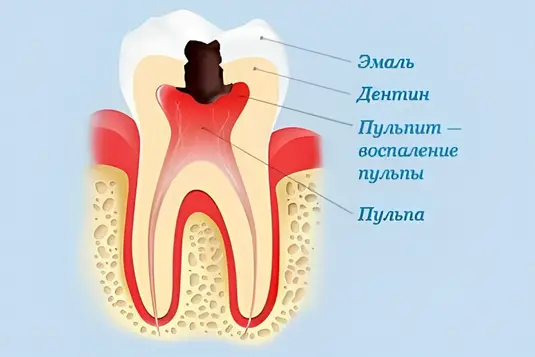
Tooth pulp and its importance for dental health
A tooth consists of two parts: the root, which is located in the gum, and the crown, which rises above the gum. In order to protect the internal tissues of the tooth, and also for beauty, its surface is covered with enamel. Under the enamel there is an important tooth tissue that provides protection and strength - dentin. And under the dentin there is another very important life-supporting tissue of the tooth - the pulp. Thanks to it, our teeth receive nutrients, it «guards» the entrance to the root system, and it signals pain when something is wrong in the tooth area.
The pulp is a loose substance consisting of various cellular structures, connective elastin fibers, and collagen tissues. The outline of the pulp repeats the external shape of the tooth. The importance of the pulp for dental health is very great. The pulp contains blood vessels, nerve fibers, and various receptors. It completely fills the tooth cavity and ensures its vital activity by maintaining metabolic processes in the tissues.
Main functions of tooth pulp
Each organ, tissue, and vessel has its own essential functions aimed at performing certain actions. The important functions of the pulp are:
- Plastic - formation of dentin, the main tissue of the tooth;
- Sensory - due to the large number of nerve endings, the pulp conducts various nerve signals and nutrients;
- Protective - it creates a powerful biological barrier due to a variety of protective cells.
The formation of tooth pulp occurs during embryogenesis and initially takes the form of a tooth plate. At the time of tooth maturation and eruption, the tissues of the tooth grow: the pulp and dentin.
In the event of a carious process in the tooth cavity, the pulp stimulates the regeneration of replacement dentin. With age, the number of pulp cells decreases, collagen in the tissues changes its chemical composition, regression of nerve fibers increases, and their sensitivity decreases.
Unfortunately, although the pulp is protected by dentin and enamel, it is not invulnerable to infection. And once again, the culprits are pathogenic bacteria - microbes that penetrate the pulp through untreated caries or gingivitis.
The causative agents of pulpitis are various types of coccal bacteria. In the acute stage, pulpitis is characterized by swelling in the area of inflammation, tissue suppuration, and severe pain. If the health of the teeth and oral cavity is not taken care of in time, pulpitis turns into a prolonged chronic form with periods of exacerbation. Over time, pulpitis goes through three stages: a reversible process, an irreversible process, and necrosis of the pulp tissues.
To preserve the health and beauty of your teeth, be vigilant and consult a dentist at the very first symptoms of any dental disease.
Special offer
 -10%
-10%
Support for Internally Displaced Persons
The war has forced thousands of people to leave their homes in search of safety. At Club 32, we understand how important it is to support those facing such difficult circumstances. To assist internally displaced persons, our clinic offers special terms for receiving quality dental care.
We want every patient to be able to take timely care of their dental health during this difficult period. Further details about the program and eligibility requirements are available from our clinic administrators when booking an appointment.
Sign up for a consultation Read more -30%
-30%
Treatment for Military Personnel
The war in Ukraine continues, and each of us understands how important it is to support those who defend our country. Club 32 Dental Clinic sincerely thanks all service members for their courage, selflessness, and unbreakable spirit. We understand that access to quality medical care, including dental care, is an essential part of maintaining good health. That is why our clinic has developed special support programs for the defenders of Ukraine.
We stand with you.
Pictured is Maryna Shmanchuk, a servicewoman in the Armed Forces of Ukraine.
Sign up for a consultation Read moreArticle author
 20 years of experience
IrynaLukashyk
Dentist
more
20 years of experience
IrynaLukashyk
Dentist
more