


 077 900 32 32
How stress and anxiety reshape your jaw and damage your teeth
 Creation date
18.10.2025
Creation date
18.10.2025
Content of the article:
The invisible war stress wages against your smileHow stress hits your teeth: 4 major blowsHormonal attack: cortisol against your gumsUnconscious nighttime warfare: teeth grindingA dried-up river: salivation stopsBehavioral trap: when you simply do not have the energy for hygieneThe stressful day is over, but are your jaws still clenched? At Club32, we explore the connection between emotional strain and oral health. Sometimes, familiar sensations and subtle changes in self-care offer a reason to discuss not only your teeth with your dentist, but also the tension in your daily life.
In this article, we look at four ways stress can affect your smile, from physical responses to everyday habits. Read on to discover which signs deserve attention and what to bring up at your dental consultation.
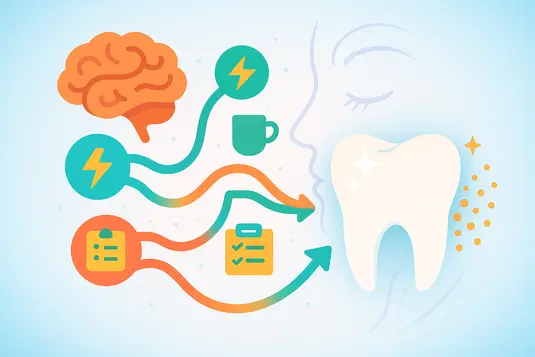
The invisible war stress wages against your smile
Have you ever felt like your jaw hurts after a stressful day? Or your gums suddenly start bleeding even though you have not changed anything in your usual hygiene routine? We tend to think of stress as something invisible that exists only in the head. But in reality, it is a powerful physical force that wages a quiet, destructive war against your smile.
This is not just a bad mood. It is a real hormonal attack that weakens your gums' defenses. It is nervous tension that makes you unconsciously clench your teeth until they crack. It is even a change in behavior that pushes self-care into the background. Your dentist may be the first person to notice signs of chronic exhaustion. Let us take a closer look at how this invisible enemy works.
How stress hits your teeth: 4 major blows
Psychological tension is not an abstract concept. It triggers very specific biochemical and physical processes in the body that directly damage your teeth and gums. Imagine that your body is a well-fortified fortress, and stress is a cunning enemy who knows all its weak points. And unfortunately, the oral cavity is one of its favorite targets. It does not launch a frontal attack. Instead, it acts insidiously, slowly destroying your defenses from within by using four main tactics.
Hormonal attack: cortisol against your gums
When you are in a state of chronic stress, your body produces excess cortisol - the so-called «stress hormone». It is needed for short-term reactions to give you energy for «fight or flight». This is an ancient survival mechanism. But when its level remains elevated day after day, it begins to destroy your fortress from within.
What does it do to your gums? First, it literally shuts down your local immunity. Your gums become much more vulnerable to bacteria that cause inflammation, known as gingivitis and periodontitis. That is why, even with perfect hygiene, they may suddenly start bleeding and hurting. This is your body signaling that its protective forces are depleted and can no longer hold back the pressure of microbes.
Second, cortisol directly contributes to the breakdown of collagen. And what is collagen for your teeth? Imagine it as thousands of strong ropes holding every tooth in the jaw. Stress makes those ropes weaken, as if they were slowly fraying. Its destruction can lead to loosening and even loss of teeth that appear completely healthy at first glance.
Unconscious nighttime warfare: teeth grinding
The most physical and destructive manifestation of stress is unconscious teeth grinding and strong jaw clenching, especially at night. This is a direct reaction of the nervous system to emotional overload. While you sleep, your brain tries to «digest» the problems of the day, and this turns into uncontrolled physical tension. The force of jaw clenching during this nighttime «training session» can exceed the force of normal chewing many times over.
The consequences can be catastrophic and often appear gradually. Teeth wear down, become noticeably shorter, and develop sharp edges. Enamel, the hardest tissue in the body, cracks, making teeth extremely sensitive to cold, hot, and acidic foods. Chips often appear and require restoration. In addition, chronic pain develops: you wake up with tired jaws, headaches, neck pain, and even ear pain. Many people do not even realize that they do this in their sleep.
A dried-up river: salivation stops
Stress activates the body's ancient «fight or flight» mechanism. Imagine that you have encountered a predator. Your body is not focused on digestion - it needs to survive. That is why one of the first reactions is a sharp decrease in saliva production. This leads to dry mouth. Why is that so dangerous? Because saliva is your natural defender, the true guardian of oral health.
Imagine that saliva is a river constantly washing over your teeth. It neutralizes the acids produced after every meal that erode enamel. It washes away food debris and prevents bacteria from holding feasts that end in tooth decay. It also contains antibacterial enzymes that fight germs. When this river dries up, the mouth becomes an ideal «greenhouse» for the rapid development of cavities and bacteria that cause bad breath.
Behavioral trap: when you simply do not have the energy for hygiene
Let us be honest. In a state of stress and emotional burnout, it is hard to take care of yourself. You barely have enough energy for the basics, and things like thorough brushing, flossing, and using an irrigator feel like difficult, energy-consuming tasks that are easy to postpone. «I will brush tomorrow morning», you tell yourself, and that «tomorrow» can last for weeks, turning into systematic neglect of hygiene.
On top of that comes an irresistible craving for «comfort» food - usually sweet and unhealthy food that acts as direct fuel for cavity-causing bacteria. This creates a double blow to your smile: not only do you clean your «home» less carefully, but you also invite the destroyers in and feed them generously. This creates a vicious circle that is very difficult to break.
Do not let stress quietly destroy your smile. If you notice these symptoms in yourself, it is a signal. Book a consultation to create a protection plan for your teeth.
Special offer
 -10%
-10%
Support for Internally Displaced Persons
The war has forced thousands of people to leave their homes in search of safety. At Club 32, we understand how important it is to support those facing such difficult circumstances. To assist internally displaced persons, our clinic offers special terms for receiving quality dental care.
We want every patient to be able to take timely care of their dental health during this difficult period. Further details about the program and eligibility requirements are available from our clinic administrators when booking an appointment.
Sign up for a consultation Read more -30%
-30%
Treatment for Military Personnel
The war in Ukraine continues, and each of us understands how important it is to support those who defend our country. Club 32 Dental Clinic sincerely thanks all service members for their courage, selflessness, and unbreakable spirit. We understand that access to quality medical care, including dental care, is an essential part of maintaining good health. That is why our clinic has developed special support programs for the defenders of Ukraine.
We stand with you.
Pictured is Maryna Shmanchuk, a servicewoman in the Armed Forces of Ukraine.
Sign up for a consultation Read more

Frequently asked questions
Can a dentist really see that I am stressed?
Yes, absolutely. A dentist cannot see your thoughts, but they can see the physical effects of stress: characteristic worn tooth surfaces, microcracks in the enamel, acute gum inflammation that does not correspond to the level of hygiene, and they can also diagnose severe tension in the jaw muscles.
I grind my teeth at night. What should I do?
First of all, see your dentist. The most effective way to protect your teeth from further damage is to have a custom night guard made. It does not treat the cause, but it takes the brunt of the impact, protecting your enamel. At the same time, it is worth working on the root cause.
Can constant dry mouth be related only to stress?
Although stress is a common cause, dry mouth can also be a side effect of certain medications, a symptom of certain diseases such as diabetes, or a result of dehydration. If this symptom bothers you constantly, discuss it with both your dentist and your family doctor.