Treatment of pulpitis in baby teeth in children is a necessary measure for the normal development of a child's dentofacial system.
Pulpitis is an inflammation of the inner part of the tooth, consisting of soft tissues – nerve endings, blood vessels, and connective tissue.
Treatment of pulpitis in children's milk teeth is one of the most important procedures in pediatric dentistry. Its goals are to stop inflammation, preserve temporary teeth until they are naturally replaced, and prevent complications that could affect the formation of permanent teeth and healthy bite development.
Liudmyla Ivanivna Romyhailo, a pediatric dentist at Club 32, a family dentistry clinic in the Holosiivskyi district of Kyiv, has extensive experience in treating pulpitis in primary teeth in children. She loves and understands her young patients, and they are always happy to see her.
Our clinic has created the ideal conditions for your child to feel relaxed and unafraid of dental treatment, both before and during the procedure. The fairy-tale interior of the children's office, introductory visits, cartoons during procedures, toys and certificates as gifts, as well as colored fillings for baby teeth – all this turns your child's visit to us into a joyful and exciting adventure.
Our dentistry offers gentle and safe methods for painless and effective treatment of pulpitis in children. Remember, proper and timely treatment of baby teeth prevents the spread of infection, preserves space for permanent teeth, and promotes the harmonious development of the entire dentofacial system. Seeing a pediatric dentist at the first sign of pain or discomfort after an injury helps avoid complications and creates a positive experience for the child, which is extremely important for their future life. In addition, you can pay for the treatment of pulpitis in baby teeth in installments and without overpaying.
Causes of pulpitis in baby teeth in children
Pulpitis in baby teeth is most often the result of untreated or undetected caries. Children's tooth enamel is thinner and softer than that of adults, so infection quickly destroys it and penetrates deep into the tooth, where it affects the pulp. In addition, pulpitis can be caused by trauma, congenital weakness of hard tissues, errors in the treatment of caries, poor oral hygiene, and frequent consumption of sweets and sticky carbohydrates. The risk of active caries with pulp damage increases with decreased immunity and chronic diseases.
Symptoms of pulpitis in children
The first signs are nighttime pain and sensitivity to hot or cold temperatures. Other symptoms may include gum swelling or tooth discoloration. Bad breath may also develop. The child may become irritable and refuse to eat.
Due to the structure of baby teeth, pulpitis in children progresses faster than in adults and can affect the buds of permanent teeth. Therefore, at the slightest complaint, it is necessary to urgently consult a dentist. Otherwise, acute pulpitis in children can become chronic, requiring more complex and expensive treatment.
Types of pulpitis in baby teeth
Pulpitis in children can vary in severity, from mild inflammation to severe forms accompanied by severe pain and destruction of tooth tissue. In order to select the right treatment, the dentist determines the type of pulpitis based on clinical symptoms and examination results.
There are several types of this disease:
Acute pulpitis of deciduous teeth
Develops rapidly, most often as a complication of deep caries. It is characterized by severe pain, especially at night, increased sensitivity to temperature, and possible swelling of the gums.
There are several subtypes:
- Acute serous (diffuse) - inflammation of the pulp without pus, paroxysmal pain that radiates to adjacent teeth or the ear
- Acute purulent - pus accumulates in the pulp, the pain becomes throbbing, intensifies when tilting the head, touching, or biting
Chronic pulpitis of deciduous teeth
Occurs when acute pulpitis is not treated in a timely manner. Symptoms are less pronounced: periodic pain, darkening of the tooth, unpleasant odor from the mouth.
There are several types:
- Chronic fibrous - the pulp partially retains its viability, the pain is aching and periodic
- Chronic gangrenous - pulp tissue is destroyed, a persistent unpleasant odor appears, the tooth darkens
- Chronic hypertrophic - a soft polyp grows from the pulp, which may bleed when eating
Exacerbation of chronic pulpitis
May develop with weakened immunity or reinfection. The pain becomes acute, similar to attacks of acute pulpitis, the gums become inflamed, and sometimes swelling occurs.
Traumatic pulpitis
Occurs when a tooth is damaged (chipped, cracked, or knocked) and infection can reach the pulp. It manifests as sharp pain and sensitivity to temperature.
Methods of treating pulpitis in children
The treatment strategy for pulpitis in primary (baby) teeth in children is selected individually, taking into account the child's age, the depth of inflammation, and the condition of the permanent teeth. The main goal of the dentist is to preserve the living pulp and prolong the life of the tooth until it is naturally replaced.
Today, there are international protocols governing these types of treatment.
Biological (conservative) method
Used for reversible pulpitis, when the inflammation has not yet penetrated deep into the pulp and is limited to the upper layers of dentin — the pulp tissue is only irritated, but not destroyed.
How it is performed:
- The dentist completely removes the carious tissue without opening the pulp chamber
- A therapeutic lining is placed at the bottom of the cavity
- A permanent, airtight filling is placed
This treatment promotes tissue repair and the formation of secondary dentin, a natural protective barrier over the pulp.
It is important to understand the difference:
- If the caries is deep but the pulp is not exposed, the inflammation is reversible, and the biological method is effective
- If the pulp is exposed but bleeding is minimal and the tissue is viable, a direct pulp capping method is used - similar in essence, but with treatment of the exposed area itself
- When the inflammation has spread throughout the pulp and is accompanied by pain, conservative treatment is no longer appropriate - vital amputation or pulpectomy is required
Vital amputation (pulpotomy)
Used for limited acute pulpitis, when the inflammation is localized in the crown part of the pulp.
Under local anesthesia, the doctor removes the affected part of the pulp, treats the cavity with an antiseptic, and applies a therapeutic material, preserving the viable root part.
Devital amputation and pulpectomy
If the inflammation has spread to the entire pulp or suppuration has occurred, methods of partial or complete removal are used.
Devital amputation involves the use of a special paste that temporarily "kills" the pulp for subsequent painless removal.
During pulpectomy, all pulp is removed from the crown and root parts of the tooth, and the canals are filled with biocompatible materials that dissolve during natural tooth replacement.
Surgical treatment (tooth extraction)
Extraction is performed only when it is impossible to save the tooth - for example, in cases of purulent tissue melting or destruction of the crown down to the gum line.
Treatment of pulpitis in children in one visit is possible in cases of:
- reversible pulpitis (biological method),
- limited serous inflammation (vital amputation),
- traumatic pulp exposure without signs of pus
The main condition is pulp viability, absence of pain after anesthesia, and easy hemostasis (blood clotting).
Stages of treating pulpitis in primary teeth in children:
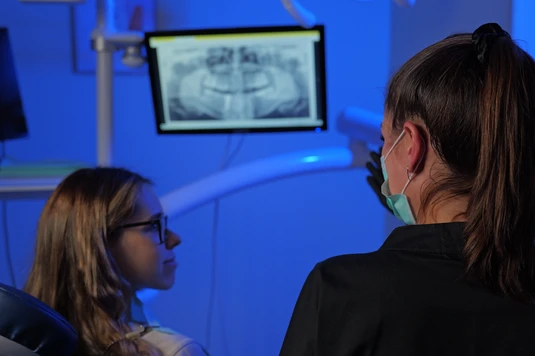
- Initial examination and X-ray diagnosis
- Pain relief using safe anesthetics
- Isolation of the working area and preparation of the tooth
- If necessary, removal of the inflamed pulp – partial or complete
- Treatment with antiseptics and, if necessary, filling of the canals with special materials
- Restoration of the tooth with a filling or installation of a children's crown
- Follow-up observation by a dentist
Remember – if pulpitis in children's milk teeth is not treated in time, the infection can spread to the bone tissue, causing abscesses, swelling of the cheeks, and even damage to the buds of permanent teeth. In the future, this will lead to malocclusion and the need for complex and expensive orthodontic treatment. Therefore, at the first symptoms, it is necessary to immediately seek professional help.
Come to Club 32, and our pediatric dentist will restore your child's dental health.
Book a consultation now!
📞 (077) 900 32 32 ( 👉 Viber, 👉 WhatsApp, 👉 Telegram )
📍 Address: Kyiv, Stepana Rudnytskoho St 15, building 3
Instagram: instagram.com/club32.ua
Facebook: facebook.com/club32.ua



 077 900 32 32