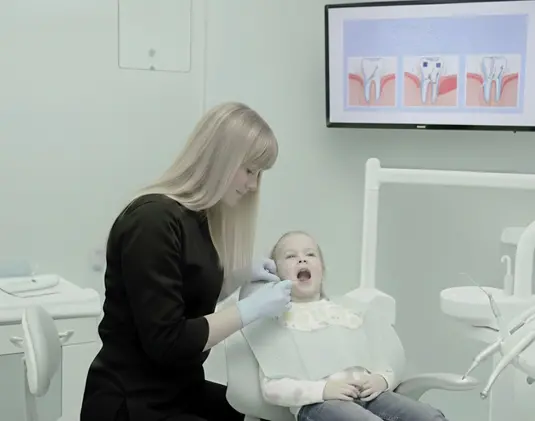
Painless and stress-free removal of baby teeth
Our doctors always make every effort to preserve children's baby teeth until they are naturally replaced and to avoid extraction. However, sometimes this is not possible for objective reasons. In such cases, we perform the procedure of removing baby teeth so that the child experiences neither pain nor fear, and after the treatment is complete, they are left with only pleasant memories instead of stress.
Parents should know that the procedure of removing a tooth (teeth) in children is sometimes called an operation, but this is nothing more than medical terminology. Removal refers to the field of surgery, and the actions of surgeons are commonly referred to as "operations." Therefore, there is no need to be afraid of the word "operation" in this context.
Lyudmila Ivanovna Romygailo, a pediatric dentist at Club 32, a family dentistry clinic in the Holosiivskyi district of Kyiv, has extensive experience in the successful and complication-free removal of baby teeth in children of all ages. She loves and understands children, and they are always happy to see her.
Our clinic has created the ideal conditions for your child to feel calm and relaxed, both before and during treatment, so that they are not afraid of being treated. The fairy-tale interior of the children's office, introductory visits, cartoons during procedures, toys, and certificates as gifts—all this turns your child's visit to us into a joyful and exciting adventure.
In addition, we offer the option of paying for treatment in installments and without overpayments, which is especially convenient if your child needs to have a baby tooth removed (extracted) urgently.
Reasons for removing children's baby teeth
Baby teeth are only removed for medical reasons, when it is no longer possible to save the tooth or its presence threatens the normal development of permanent teeth and the formation of a healthy bite in the child. The most common reasons include:
Deep caries and its complications
Advanced caries is the main reason for removing baby teeth. If the damage has reached the pulp and caused pulpitis or periodontitis, the tooth becomes a source of constant inflammation. It is often impossible to cure such teeth, and the doctor recommends removal to protect the permanent teeth.
Chronic infection, cysts, and fistulas
If there is a cyst, fistula, abscess, or granuloma at the root of a baby tooth, removal is necessary to prevent the infection from spreading to the soft tissues and developing permanent teeth.
Lack of root resorption and delayed natural loss
Sometimes the roots of a baby tooth do not resorb on time. Such a tooth does not wobble or fall out, preventing the permanent tooth from erupting. Removal prevents bite deformation and misalignment of permanent teeth.
Incorrect eruption of a permanent tooth ("shark teeth")
If a permanent tooth has already erupted behind or in front of a baby tooth, and the baby tooth has not fallen out, a "double row" occurs. Removing the baby tooth frees up space and helps the permanent tooth take its correct position.
Trauma and fractures of the baby tooth
Falls or blows can break a baby tooth, displace it, or damage the surrounding tissue. If it cannot be restored or there is a risk of injury to the permanent tooth bud, removal is recommended.
Severely damaged crown, impossible to restore
If only part of the crown remains of a baby tooth or the walls are thin and brittle, filling or installing a children's crown is impossible. Such a tooth must be removed to avoid chronic inflammation.
Orthodontic indications
As part of bite correction, an orthodontist may recommend the planned removal of individual baby teeth to free up space and prevent crowding or misalignment of permanent teeth.
Contraindications to tooth extraction in children
The removal of children's (baby) teeth is postponed in conditions that may complicate the procedure or slow down healing.
The main contraindications are:
- Acute infections and fever — SARS, flu, tonsillitis, and any diseases with fever
- Inflammation in the oral cavity — gingivitis, stomatitis, severe swelling, or ulcerative lesions of the mucous membrane
- Blood clotting disorders — hemophilia, thrombocytopenia, or uncontrolled use of anticoagulants
- Allergy to anesthetics — requires selection of an alternative drug or additional diagnosis
- Exacerbation of chronic diseases — bronchial asthma, diabetes mellitus, cardiovascular pathologies in a state of decompensation
- Severe inflammation in the area of adjacent teeth — treatment is first carried out to reduce the risk of complications
- Psychological unpreparedness of the child — pronounced fear, panic, or inability to cooperate during the procedure
How temporary and permanent teeth are removed in children
The removal of baby teeth in children is carried out according to a strict protocol that ensures safety, painlessness, and minimal tissue trauma. Depending on the clinical situation, the procedure may be simple or more technically complex, but in any case, it is performed with the utmost care. Here are the stages of the procedure.
Examination and diagnosis
The dentist assesses the degree of tooth mobility, the condition of the roots, the presence of inflammation, and the position of the permanent tooth bud. If necessary, an X-ray is taken to rule out hidden processes or atypical root anatomy.
Choice of anesthesia
Local anesthesia adapted for children is used. It ensures complete absence of pain during the procedure and helps the child remain calm. Our clinic also offers tooth extraction (pulling) under sedation. It is completely safe and guarantees 100% absence of any discomfort or stress.
Removal of temporary teeth
If the roots of the baby tooth have already partially dissolved, the procedure is quick and easy. The dentist carefully loosens the tooth with special instruments and removes it without damaging the surrounding tissues. This type of extraction is usually accompanied by minimal discomfort and does not cause significant bleeding.
Removal of permanent teeth in children
When a permanent tooth needs to be removed, the procedure involves more thorough preparation.
The dental surgeon:
- provides full anesthesia,
- assesses the location of the roots and access to them,
- separates the roots if necessary to extract the tooth atraumatically,
- treats the socket with an antiseptic to prevent inflammation
- If the root location is not inflamed, a single-stage artificial root implantation is possible for further prosthetics
Completion of the procedure
After removal, the socket is filled with hemostatic or protective material. The doctor explains to the parents how to care for the extraction site during the first 24 hours: what to avoid, when to drink and eat, and how to monitor the child's condition.
Recommendations after the removal of a child's tooth
To avoid complications after the removal of baby teeth in children, it is important to follow a few simple rules:
- do not eat or drink hot beverages for two hours
- the child should not touch the socket with their tongue or hands
- active games should be avoided for the first 24 hours
- Do not rinse your mouth
- Clean adjacent teeth carefully
If necessary, the doctor will prescribe additional care products. If the recommendations are followed, the socket will heal quickly and without complications.
Proper and timely removal of temporary (baby) teeth in children helps to maintain the health of permanent teeth, ensure healthy bite development, and prevent serious problems in the future. Our specialists use gentle techniques to minimize tissue trauma and speed up the recovery process. This makes treatment safe and predictable. In addition, our dental clinic pays special attention to the psychological comfort of our young patients.
We guarantee European quality, affordable prices, and friendly service.
Book a consultation now!
📞 (067) 382 32 32 ( 👉 Viber, 👉 WhatsUp, 👉 Telegram )
📍 Address: Kyiv, Stepana Rudnytskoho St 15, building 3
Instagram: instagram.com/club32.ua
Facebook: facebook.com/club32.ua