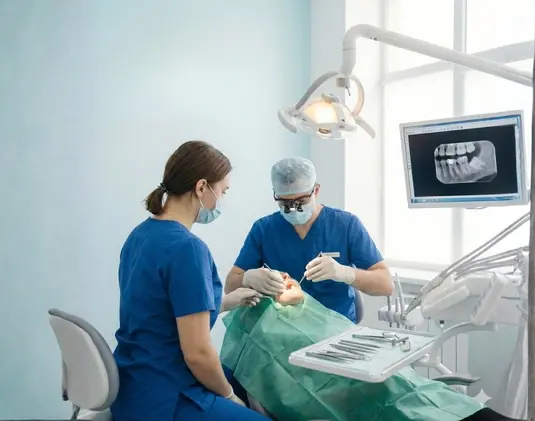
Removal of impacted wisdom teeth – pain relief and prevention of possible complications
An impacted wisdom tooth is a molar (also known as a "third molar") that has formed successfully but has not been able to break through the gum. Such an abnormal tooth may remain completely hidden in the bone tissue or partially under the gum. This condition of "eights" often leads to chronic pain, inflammation, and problems with adjacent teeth. Although such a tooth is not visible, it greatly affects the condition of the oral cavity and overall well-being. Patients with impacted wisdom teeth often complain of pain when chewing, swelling, unpleasant odor, or discomfort in the jaw area. To get rid of these problems and avoid complications in the future, we recommend removing the impacted wisdom tooth from the gum.
The surgeons at Club 32, a family dental clinic in the Holosiivskyi district of Kyiv, have extensive experience in removing wisdom teeth that remain inside the gums.
If necessary, you can have all procedures related to the removal of an unerupted wisdom tooth performed right here at our clinic at a reasonable price.
For those patients who are very anxious or simply afraid of such procedures, we have a special offer – removal under sedation. Although this increases the cost of treatment, it allows for the removal of impacted wisdom teeth not only without pain, but also without stress.
We always make every effort to solve your problem and maintain your long-term health.
In addition, you can pay for the removal of a hidden wisdom tooth in installments and without overpaying.
We do everything to make your treatment effective, affordable, and comfortable.
Indications for the removal of impacted wisdom teeth:
- Chronic inflammation (pericoronitis) caused by the accumulation of bacteria and food debris under the gum flap, accompanied by swelling and unpleasant odor
- Severe pain or regular recurrence of inflammatory processes, significantly impairing the patient's quality of life
- Incorrect tooth position: horizontal or angular growth with the risk of damage to adjacent molars, development of caries and periodontitis
- Lack of space in the dental arch, which causes misalignment of the bite, crowding of teeth, and makes oral hygiene difficult
- The presence of cysts or resorption of the roots of adjacent teeth, identified by CT or X-ray examination
- An obstacle to orthodontic treatment or prosthetics, when a wisdom tooth interferes with the correct position of the orthodontic structure
- Cases where a retained wisdom tooth is a source of chronic infection, which can negatively affect not only dental health but also overall health
Reasons for removing a wisdom tooth that has not erupted
The main reason for removing a wisdom tooth that is completely hidden inside the gum or has partially erupted is chronic inflammation caused by this pathological condition.
In addition, problematic wisdom teeth need to be removed because they often become a source of constant pain, swelling, and bad breath. Sometimes they can interfere with the normal development of the dentition, cause damage to the roots of adjacent teeth, and lead to the formation of cysts.
Naturally, in all these cases, the dentist prescribes surgery to remove the wisdom tooth, which is completely or partially hidden in the gum. If the problem is ignored, the consequences can be much more serious than the surgery itself.
Stages of complex removal of an impacted wisdom tooth
- Removing wisdom teeth that have not grown out of the gums is a surgical procedure that requires a highly skilled dental surgeon. Unlike standard removal, it is not possible to simply grasp the tooth with forceps and extract it. The roots are often curved, and the teeth themselves remain partially or completely in the gum or are positioned at an angle. In addition, wisdom teeth are located near important anatomical structures, so any inaccuracy in the preparation and performance of the operation can lead to complications. These include damage to the inferior alveolar nerve, manifested by temporary or permanent numbness of the lower lip and chin. That is why at the Club 32 clinic, only experienced surgeons perform the removal of wisdom teeth that remain in the gums.
- Before the operation, the patient undergoes a mandatory examination. First, an X-ray or computed tomography (CT) scan is performed to accurately determine the position of the impacted wisdom tooth, its depth, the direction of root growth, and its proximity to anatomically important structures. Based on the images, the doctor assesses the degree of complexity of the intervention and selects the optimal method of surgery.
- Preparation also includes collecting medical history and ruling out contraindications: allergies to anesthetics, acute inflammatory processes, chronic diseases in the acute stage. If necessary, additional tests are prescribed — a complete blood count, coagulogram, consultations with related specialists.
- The removal itself begins with thorough local anesthesia. If necessary, sedation is used, which not only guarantees the absence of pain, but also a relaxed state of the patient, as well as minimization of stress. The surgeon then makes an incision in the mucous membrane and peels back the gum flap to access the tooth and bone. If the tooth is deeply embedded, partial removal of bone tissue may be necessary using a drill or piezoelectric surgical instrument.
- The wisdom tooth is carefully divided into fragments: the crown is separated from the roots. This step-by-step method reduces trauma and minimizes stress on adjacent teeth. The fragments are removed using elevators and forceps. After all parts have been removed, the socket is cleaned, treated with an antiseptic, and carefully checked for bone or enamel fragments.
- In the final stage, the surgeon applies self-absorbing sutures and gives recommendations for postoperative wound care. On average, the entire procedure takes 30 to 60 minutes, depending on the complexity of the case.
- After the procedure, the patient is prescribed a course of painkillers and antiseptic rinses.
Recommendations include limiting physical activity and avoiding hot foods for several days.
Advantages of wisdom tooth removal from the gums at our dental clinic
We use only modern diagnostic methods (X-ray, CT) and gentle surgical techniques. If necessary, sedation is used to help the patient feel as calm and relaxed as possible. Experienced surgeons ensure safe and minimally traumatic wisdom tooth removal from the gums, which reduces the risk of complications and speeds up the healing process. The clinic provides all the conditions for comfortable treatment and quick recovery.
Recommendations after removal of an impacted wisdom tooth
In the first 24 hours after surgery, it is important to apply cold to the cheek to reduce swelling and avoid hot food. It is not recommended to rinse your mouth, drink through a straw, or touch the wound with your tongue. Your diet should be soft and gentle. Smoking and alcohol slow down healing, so it is best to avoid them. Maintain good oral hygiene, but be careful around the stitches. If you experience pain, take the medication prescribed by your doctor and be sure to come in for follow-up appointments.
If you need safe and stress-free complex removal of an impacted wisdom tooth, welcome to Club 32, a family dental clinic in the Holosiivskyi district of Kyiv.
We employ highly skilled and experienced surgeons who use the most advanced dental technologies.
We guarantee European quality, affordable prices, and friendly service.
Book a consultation now!
📞 (067) 382 32 32 ( 👉 Viber, 👉 WhatsUp, 👉 Telegram )
📍 Address: Kyiv, Stepana Rudnytskoho St 15, building 3
Instagram: instagram.com/club32.ua
Facebook: facebook.com/club32.ua