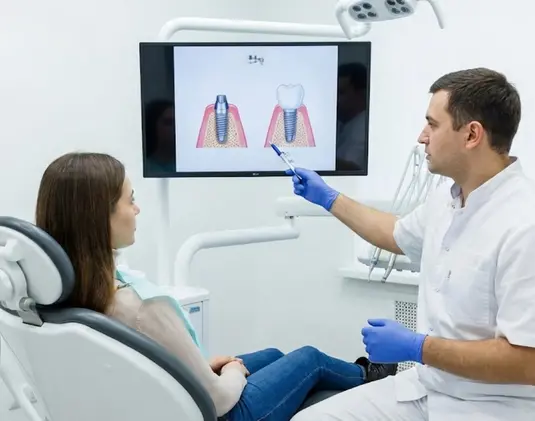
Two-stage dental implantation
This is a classic protocol for restoring lost teeth, already familiar to many patients, in which the implant is installed and the permanent crown is fixed during several visits to the implant surgeon. According to global dental statistics, the survival rate of implants installed using this protocol reaches 99%. Therefore, it is sometimes called the gold standard of implantology.
The method is successfully used both for the restoration of a single tooth and for partial or complete edentulism. Two-stage implantation allows for a controlled and predictable result in situations where a single-stage protocol cannot be applied for clinical reasons.
The implantologists at Club 32, a family dental clinic in the Holosiivskyi district of Kyiv, have extensive experience in performing two-stage dental implantation for patients of all ages. Our clinic has all the necessary diagnostic and surgical equipment to perform this type of implantation and subsequent prosthetics.
We develop an individual treatment plan for each patient that fully corresponds to their clinical situation and wishes. This allows us to perform implantation in the most comfortable conditions and achieve long-term treatment results. In addition, you can pay for two-stage implantation in installments and without overpaying.
Indications for two-stage dental implantation
Two-stage implantation is not a "more complex" alternative to the one-stage protocol, but is a method that is chosen strictly according to the indications listed below.
Insufficient primary stability
If the density or volume of bone tissue does not allow for reliable fixation of the implant with immediate loading, a two-stage protocol is preferred. Closed healing reduces the risk of micro-movements and increases the likelihood of successful osseointegration.
Bone tissue deficiency and the need for bone grafting
In cases of severe bone atrophy or simultaneous bone augmentation, it is important to minimize the load on the implant during the healing period. The two-stage technique allows the intervention area to be isolated and creates optimal conditions for the formation of new bone tissue.
Presence of inflammation
If the tooth was extracted against a background of chronic inflammation or infection, the doctor may opt for two-stage implantation to ensure safer healing control. This reduces the likelihood of complications and infection of the implant.
Complex anatomical conditions
The proximity of the maxillary sinuses, mandibular nerve, or pronounced defects in the bone walls require careful and step-by-step treatment. In such cases, closed healing increases the predictability of the result.
Increased functional loads
When planning implantation in the chewing area or in cases of pronounced bruxism, a two-stage protocol allows you to avoid early overload of the implant and ensure its complete fusion with the bone.
General somatic risk factors
Patients with concomitant chronic diseases, reduced tissue regeneration, or smoking often require a more cautious approach. Two-stage implantation makes it possible to control each stage of treatment and minimize risks.
The final decision on the choice of implantation protocol is made after comprehensive diagnostics: clinical examination, computed tomography, and assessment of bone tissue condition. It is the individual approach that allows you to choose the optimal treatment strategy and achieve predictable functional and aesthetic results.
Contraindications to two-stage dental implantation
Despite its high effectiveness, two-stage dental implantation has a number of contraindications. Absolute contraindications include decompensated systemic diseases, severe blood clotting disorders, active cancer, and uncontrolled diabetes mellitus.
Temporary contraindications include acute inflammatory diseases of the oral cavity, active infections, and exacerbations of chronic pathologies. Once the patient's condition has stabilized, implantation can be performed. The decision on the feasibility of the procedure is made after comprehensive diagnosis and risk assessment.
The procedure for two-stage dental implantation
Diagnosis and planning
Treatment begins with a consultation and comprehensive diagnosis. A CT scan is performed to assess the volume and density of bone tissue, anatomical features, and bite. Digital planning is carried out based on the data. If necessary, an individual surgical template is made, which allows the implant to be placed as accurately as possible, taking into account the depth and angle of inclination.
First surgical stage — implant placement
The implant is placed in the bone tissue under local anesthesia. At the patient's request or in cases of increased anxiety, the operation can be performed under sedation. After fixation, the implant is completely covered by the mucous membrane. This isolation from the oral cavity eliminates stress and reduces the risk of infection during the healing period.
Osseointegration period
Over the course of 3-6 months, the implant fuses with the bone tissue. During this period, the patient follows the doctor's recommendations and undergoes follow-up examinations. The absence of functional stress promotes the formation of strong bone contact.
Second surgical stage
After confirmation of engraftment, the implant is exposed. The procedure is performed under local anesthesia, with sedation also possible if necessary. A gum former is installed to create the correct contour of the soft tissues. After a few weeks, the former is replaced with an abutment — a connecting element between the implant and the crown.
Prosthetic stage
After the abutment is installed, a permanent crown is made and fixed in place. Its shape and color are selected so that the restored tooth looks natural and participates fully in chewing.
Two-stage implantation allows you to control each stage of treatment, minimize risks, and ensure predictable functional and aesthetic results even in complex clinical conditions.
Advantages of two-stage dental implantation at Club 32
At our dental clinic, implantation is performed using modern diagnostic equipment and digital modeling. This allows us to accurately position the implant in the jaw and achieve full restoration of the dental arch function after prosthetics.
Our patients receive an individual treatment plan and support at all stages.
We achieve predictable treatment results thanks to a combination of factors:
- the highest level of professionalism of our doctors — our implant surgeon has been successfully helping patients of all ages for over 26 years and is constantly improving his qualifications;
- use of advanced dental technologies — our clinic has all the necessary equipment for digital diagnostics, oral cavity scanning, and implant planning;
- service — when you come to us for help, you can always count on the sincere interest of our doctors and staff in your health and comfort
If you need two-stage dental implantation, welcome to Club 32, a family dental clinic in the Holosiivskyi district of Kyiv.
We employ highly qualified and experienced doctors who use the most advanced dental technologies.
We guarantee European quality, affordable prices, and friendly service.
Book a consultation now!
📞 (067) 382 32 32 ( 👉 Viber, 👉 WhatsUp, 👉 Telegram )
📍 Address: Kyiv, Stepana Rudnytskoho St 15, building 3
Instagram: instagram.com/club32.ua
Facebook: facebook.com/club32.ua