Implantation of all teeth
This is the most effective way to restore the dentition in cases of partial or complete edentulism. The loss of all teeth has a complex negative effect on the body. The inability to chew, problems with digestion, diction, deterioration of facial aesthetics, problems with the temporomandibular joint, and, of course, socialization—all of these suffer from edentulism.
But there is a solution. Modern dentistry allows all teeth to be restored with the help of implants. This guarantees reliable fixation of prostheses, eliminates the problems associated with edentulism, and dramatically improves quality of life.
At the same time, patients with complete or partial edentulism do not need to have an implant installed for each lost tooth. The optimal solution in this situation is prosthetics using All-on-4 technology for the lower jaw and All-on-6 for the upper jaw.
Essentially, this involves fixing non-removable or conditionally removable prostheses on 4 implants for the lower jaw and 6 implants for the upper jaw. The use of these technologies minimizes the number of interventions, guarantees complete restoration of the function and aesthetics of the dentition, and saves the patient money.
Tooth loss over time leads to a reduction in the lower third of the face and the formation of age-related changes. Properly planned implantation allows you to restore anatomical proportions and improve the patient's appearance.
Modern protocols provide for the possibility of immediate loading, when a temporary structure is fixed shortly after the operation. This allows the patient not to remain without teeth during the period of implant engraftment and to adapt more quickly to the new conditions.
The implantologists at Club 32, a family dental clinic in the Holosiivskyi district of Kyiv, have extensive experience in restoring the dentition of patients of all ages using these technologies. Our clinic has all the necessary equipment for accurate diagnosis, implantation, and subsequent prosthetics.
Indications for full-mouth implant placement
Full-mouth dental implant is recommended in the following cases:
- complete edentulism in one or both jaws;
- multiple defects in the dentition, in which the preservation of the remaining teeth is impossible or impractical;
- tooth loss due to complicated caries, generalized periodontitis, trauma, congenital pathologies, or age-related changes;
- dissatisfaction with removable dentures (instability, displacement when talking and eating);
- the need to restore the correct distribution of chewing load and prevent bone tissue atrophy
Contraindications to full-mouth implant placement
Temporary contraindications:
- acute inflammatory processes in the oral cavity;
- exacerbation of chronic diseases;
- severe forms of gingivitis and periodontitis
- After stabilization of the condition, implantation can be performed
Permanent contraindications:
- severe systemic diseases in the stage of decompensation;
- severe blood clotting disorders;
- uncontrolled diabetes mellitus;
- conditions in which surgical intervention poses a high risk to the patient's health
The decision on the possibility of implantation is made individually after comprehensive diagnosis.
The main stages of full-mouth dental implant placement
Diagnosis and planning
Treatment begins with a consultation, photo protocol, computed tomography, and assessment of the condition of the bone tissue of both jaws. In cases of complete or severe partial edentulism, special attention is paid to the volume and density of the bone in the areas intended to support the future orthopedic structure.
Based on the diagnosis, the doctor selects the optimal implantation plan for all teeth, determines the number and location of implants, taking into account anatomical features, bite, and planned chewing load. For accurate implementation of the plan, an individual surgical template is made to ensure the correct positioning of the implants.
Bone tissue preparation (if necessary)
Prolonged absence of teeth can be accompanied by bone tissue atrophy. Modern protocols allow the use of bone areas with the highest density and, in some cases, do without preliminary bone grafting.
In cases of moderate bone deficiency, bone augmentation can be performed simultaneously with implantation. In cases of severe atrophy, the preparatory stage is carried out in advance. The location of the mandibular nerve and maxillary sinuses is always taken into account during planning, which increases the safety of treatment.
Implant placement
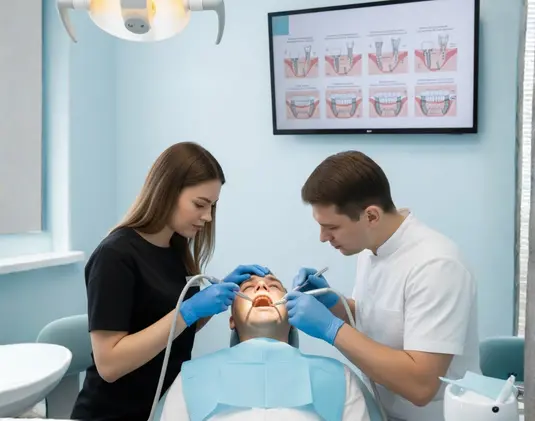
The surgical stage is performed under local anesthesia, with sedation if necessary. The required number of implants is installed, which serve as a support for a complete removable or conditionally removable prosthesis.
Precise positioning of the implants using a surgical template is key to ensuring even distribution of chewing pressure and the durability of the structure.
Healing period and temporary prosthetics
After the operation, the osseointegration phase begins, which lasts an average of 3-6 months. In some cases, a temporary orthopedic structure can be installed within 1-7 days after the surgical phase. It restores aesthetics and function, protects the implantation area, and facilitates patient adaptation.
Permanent prosthetics
After osseointegration is complete, a permanent non-removable or conditionally removable prosthesis is fixed in place. The structure completely restores the dentition, ensures stability during chewing, and provides a physiological distribution of load.
If a removable prosthesis was previously used, it can be adapted and fixed on implants.
Advantages of chewing tooth implantation at Club 32
At our dental clinic, treatment is carried out using modern diagnostic equipment and digital modeling. This allows us to precisely position implants and achieve full restoration of dental function after prosthetics.
Our patients receive a detailed treatment plan and support at all stages.
We achieve predictable treatment results thanks to a combination of factors:
- the highest level of professionalism of our doctors — our implant surgeon has been successfully helping patients of all ages for over 26 years and is constantly improving his qualifications;
- use of advanced dental technologies — our clinic has all the necessary equipment for digital diagnostics, oral cavity scanning, and implant planning;
- service — when you come to our clinic for help, you can always count on the sincere interest of our doctors and staff in your health and comfort
If you need to have all your teeth implanted, welcome to Club 32, a family dental clinic in the Holosiivskyi district of Kyiv.
We employ highly qualified and experienced doctors who use the most advanced dental technologies.
We guarantee European quality, affordable prices, and friendly service.
Book a consultation now!
📞 (067) 382 32 32 ( 👉 Viber, 👉 WhatsUp, 👉 Telegram )
📍 Address: Kyiv, Stepana Rudnytskoho St 15, building 3
Instagram: instagram.com/club32.ua
Facebook: facebook.com/club32.ua